
Subsurface Chemical Profiling: Protecting Foundation Concrete
-
The Silent Threat Beneath the Ground Surface
When designing heavy civil structures—from high-rise towers and marine quays to highway viaducts—engineering focus is predominantly placed on mechanical ground parameters such as bearing capacity, standard penetration blow counts (N-values), and settlement thresholds. However, subterranean durability is equally governed by subsurface chemical aggressiveness.
Groundwater and moisture within coastal, estuarine, and industrial soils frequently harbor high concentrations of soluble sulfates, aggressive chlorides, and acidic compounds. If unaddressed during the geotechnical investigation stage, these aggressive ions trigger irreversible chemical reactions within the hardened concrete matrix and reinforcing rebar, resulting in premature structural cracking, spalling, loss of compressive strength, and catastrophic foundation degradation.
- Degradation Mechanisms: Sulfates, Chlorides & Acidic Soils
- External Sulfate Attack (ESA) & Thaumasite Formation: Soluble sulfate ions ($SO_4^{2-}$) from magnesium, sodium, or calcium salts permeate permeable concrete, reacting with free calcium hydroxide ($Ca(OH)_2$) to form gypsum, and subsequent tricalcium aluminate ($C_3A$) hydrates to form secondary ettringite. This mineral conversion generates intense volumetric expansion (up to 200–300%), causing internal tensile micro-cracking, matrix dilation, and progressive spalling. In cold, wet conditions containing carbonate ions, sulfates can trigger the Thaumasite Form of Sulfate Attack (TSA), transforming the calcium silicate hydrate (C-S-H) binding gel into a cohesionless, pulpy mush.
- Chloride Ingress & Rebar Depassivation: In coastal environments and saline water tables, free chloride ions ($Cl^-$) migrate through the concrete pore network. Once the critical chloride threshold is breached at the rebar depth, the protective alkaline passivation layer ($\gamma-Fe_2O_3$) on steel reinforcement is broken down. This initiates rapid localized pitting corrosion, where rust products expand up to 4 to 6 times their original steel volume, exerting extreme radial bursting pressures that crack and delaminate outer concrete cover.
- Acidic Ground & Decalcification Leaching: Organic peat soils and low-pH groundwater (pH < 5.5) continuously leach calcium out of the cement paste, depleting the structural binder and exponentially increasing matrix porosity.
- Analytical Metrology & Subsurface Testing Protocols
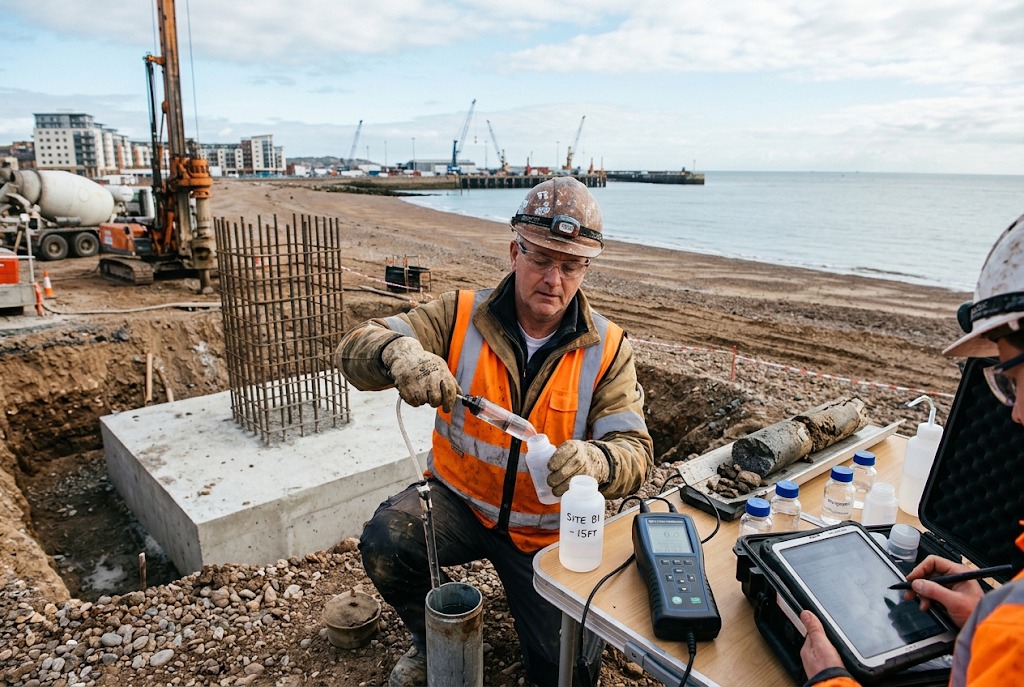
To provide structural engineers with definitive durability data, Bayleys Environmental Services integrates dedicated geochemical profiling into every soil investigation campaign. Water and soil core samples are recovered directly from exploratory boreholes and subjected to rigorous laboratory analytical chemistry:
- Water-Soluble Sulfate ($SO_4^{2-}$) Determination: Measured in 2:1 water-to-soil extracts and groundwater samples via UV-Visible Spectrophotometry and gravimetric barium sulfate precipitation in accordance with BS 1377: Part 3 and ASTM D516.
- Acid-Soluble & Water-Soluble Chloride ($Cl^-$) Profiling: Quantified via potentiometric titration (Silver Nitrate $AgNO_3$ metrology) and Ion Chromatography conforming to BS 1377: Part 3 and ASTM D512.
- pH & Electrical Conductivity (EC) Mapping: Benchtop digital electrometric determination assessing ground acidity, total dissolved solids (TDS), and soil corrosivity potential.
- Total Organic Carbon (TOC) & Organic Matter Content: Loss-on-ignition and Walkley-Black wet oxidation to assess acid-generating humic and fulvic potential.
- Engineering Standards & Aggressive Chemical Environment Classification
Subsurface chemical concentrations are mapped against international durability standards to establish formal chemical exposure classes:
- BS 8500 / BS EN 206 (Concrete Durability): Classifies ground conditions into Chemical Attack Exposure Classes (XA1: Slightly aggressive, XA2: Moderately aggressive, XA3: Highly aggressive) and Marine Chloride Classes (XS1, XS2, XS3).
- BRE Special Digest 1 (Concrete in Aggressive Ground): Determines Design Sulfate Classes (DS-1 through DS-5) and Aggressive Chemical Environment for Concrete (ACEC) classifications to dictate minimum cement content, maximum water-cement ratio, and cement type selections.
- SLS & ASTM C150 / C595 / C1157: Harmonizing local cement classifications with global performance baselines.
- Strategic Concrete & Cement Specification Blueprint
Based on laboratory chemical profiling, Bayleys provides concrete mix and cement advisory to neutralize subterranean chemical attack:
- Sulfate-Resisting Portland Cement (SRPC / Type V / CEM I-SR): For DS-2 to DS-4 conditions, specifying low Tricalcium Aluminate ($C_3A \le 3.5\% - 5.0\%$) cements eliminates the primary chemical precursor required for expansive ettringite formation.
- High-Slag & Pozzolanic Blends (CEM III/A, CEM III/B, GGBS): Incorporating 50% to 70% Ground Granulated Blast-Furnace Slag (GGBS) drastically refines the pore matrix, immobilizes free chlorides through chemical binding, and mitigates thermal cracking in mass pile foundations.
- Silica Fume & Fly Ash Blends (CEM II/B-V): Enhances microstructural density, reducing ionic permeability and diffusion rates of aggressive chloride and sulfate ions by up to 80%.
- Low Water-Binder Ratio ($w/b \le 0.40$) & Increased Cover: Enforcing strict water reduction with superplasticizers and specifying a minimum 75 mm concrete cover for underground foundations in marine-adjacent zones.
- External Barrier Systems: Specifying HDPE geomembranes, bituminous vapor barriers, or sacrificial crystalline waterproofing admixtures for severely aggressive (XA3/AC-5) terrains.
- The Bayleys Advantage: Unified Geotechnical & Chemical Intelligence
Bayleys Environmental Services (Pvt) Ltd. bridges the gap between field drilling and analytical chemistry. With in-house geotechnical rigs, environmental geologists, and analytical chemists working in synergy, we do not simply deliver soil numbers—we engineer long-lasting durability solutions that protect multi-million rupee infrastructure investments from subterranean degradation.
- Project Durability Consultation
Planning a coastal development, deep basement excavation, or marine infrastructure project? Ensure your foundation concrete is chemically engineered for the terrain.
Contact Our Durability & Geochemistry Team:
• Email: bayleyswelcome@gmail.com
• Hotline: +94 77 113 2196 / +94 76 638 3444
• Corporate Office: No. 255/9, St. Mary Estate, Wewalduwa Road, Hunupitiya, Wattala, Sri Lanka
Add New Comment